PMDD Causes vs Risk Factors
Explore the causes of PMDD, from hormonal sensitivity to genetics, and understand what factors contribute to PMDD symptoms.
Introduction to PMDD Causes
Premenstrual Dysphoric Disorder (PMDD) is a mood disorder that includes symptoms like extreme sadness, mood swings, irritability, and anxiety. These symptoms happen regularly during the premenstrual phase of the menstrual cycle and usually go away around or after menstruation1. Unlike regular premenstrual syndrome (PMS), PMDD is a more severe form of PMS that can make daily life hard. The understanding of what causes PMDD is still an active field of investigations.
In this section, we will look at the main biological, hormonal, genetic, and environmental factors that are currently linked to PMDD.
Causes vs Risk Factors: Definitions
It’s important to understand that there is a difference in the definition between causes and risk factors.
- Causes: Direct reasons that lead to PMDD symptoms, such as hormones or genetics.
- Risk factors: Things that increase the risk of developing PMDD, like a past trauma or lifestyle. The risk factors do not directly cause PMDD, but they can make it more likely for someone to have it.
Hormones in PMDD Causes
A key aspect of PMDD is how it relates to hormonal changes. PMDD symptoms often follow the menstrual cycle, especially the luteal phase, which is when estrogen and progesterone levels go up and down2 . Interestingly, women with PMDD have the same hormone levels as those without symptoms, but they are more sensitive to the normal changes in hormones like estrogen and progesterone. This extra sensitivity affects their brain and can lead to mood problems before their period2. Below, we take a deeper look at some of the possible hormonal explanations.
Progesterone and Allopregnanolone Sensitivity
Allopregnanolone is a substance made from the hormone progesterone in your body. Normally, it binds to GABA-A receptors in the brain, which act like a “calm button” that helps reduce stress and anxiety. At the start of the luteal phase, levels of progesterone and allopregnanolone drop suddenly. This sudden drop can lead to a kind of “withdrawal” that may cause PMDD symptoms like social withdrawal and low mood3. Additionally, women with PMDD may become less responsive to allopregnanolone’s calming effects2. This reduced sensitivity, or tolerance, could lead to increased anxiety and mood symptoms that are common in those with PMDD.
Estradiol, Serotonin Levels and Mood Dysregulation
Estradiol is a type of estrogen that impacts other brain substances and how they work. It boosts serotonin levels in the brain by increasing the number of serotonin receptors. Serotonin is responsible for improving mood, sleep, and thinking. In the luteal phase, when estradiol is low, serotonin also decreases. Women with PMDD may be more sensitive to this drop2. Some genetic differences related to estradiol and serotonin can make some women more likely to develop PMDD. As consequence, women with PMDD often have lower serotonin function during the luteal phase, which causes mood issues, food craving, and lack of focus. For this reason, doctors commonly use selective serotonin reuptake inhibitors (SSRIs) as the first treatment option to help increase serotonin levels in women with PMDD2.
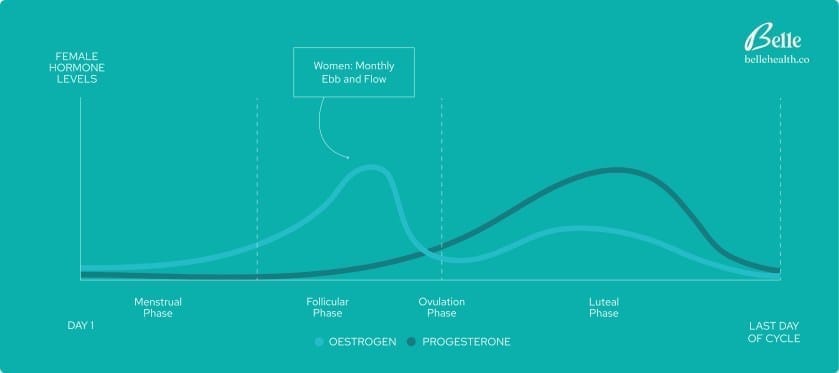
A graph illustrating the monthly ebb and flow of estrogen and progesterone levels during the four phases of the menstrual cycle, impacting mood and emotional health.
Genetic Predisposition in PMDD Causes
Genetics might make some people more likely to have PMDD. There is a lot of research on this topic and it is still ongoing. Like said before, women can present genetic differences related to estradiol and serotonin that can make them more likely to have PMDD 4,5,6,7. This means the problem might be in how sensitive they are to these hormones, not in the hormone levels themselves4, 8. There is indications that women with PMDD are more vulnerable to the effect of sex hormones at a cellular level8. Other research has found that certain genes, including those related to serotonin and estrogen, could make some people more sensitive8.
Epigenetic Changes and PMDD
Epigenetics is about how genes modify according to changes in the environment or lifestyle. These gene modifications (epigenetics) might make the brain more sensitive to hormone changes, which could explain why some women are more likely to have mood problems during their menstrual cycle. The genetics explain why PMDD occur in families, while epigenetics explain why it can be so different from one person to another, because of these modifications in the genes according to the environment8 .
Environmental and Psychosocial Risk Factors
Hormonal and genetic factors are indeed the root causes of PMDD, but the stress from life experiences can increase the chances of developing PMDD. Some of the proven risk factors are:
- Past childhood trauma: Women with negative experiences in childhood like abuse or neglect have premenstrual disorders 2.5 times more frequently than women with no trauma9. For PMDD specifically, this frequency is even higher9.
- Posttraumatic stress disorder (PTSD): PTSD and PMDD are frequently present together10. Women with a history of trauma and PTSD are over 8 times more likely to experience PMDD than those without trauma10. Also women with history of trauma without a PTSD diagnosis are more likely, nearly 3 times more chances of having PMDD10.
- Lifestyle factors: Improvements in lifestyle factors can reduce the premenstrual symptoms severity significantly11. For this reason, it is always advisable to exercise regularly, eat healthy, and manage stress11. On the other hand, the lifestyle cannot yet be considered a risk factor for PMDD, because the direct link between cause and effect hasn’t been found yet.
- Family history of PMDD: Estimates indicate that nearly 50% of the cases will lead to a familial transmission1.
Inflammation and Immune System Risk Factors
The relationship between PMDD and inflammation is an active field of research, some initial studies found that PMDD is linked to inflammation in the body2. Right before menstruation, inflammation markers rise, which may worsen symptoms like mood changes and even some conditions like inflammatory bowel syndrome. Initial research suggests women with PMDD may have higher inflammation levels than those without it2.
Quick Guide: What causes PMDD?
In summary, PMDD causes and risk factors are:
- Hormonal Sensitivity: Women with PMDD are extra sensitive to changes in hormones like progesterone and estradiol, especially during the luteal phase, causing mood symptoms.
- Genetic Predisposition: Genetic differences in hormone receptors make some women more sensitive to hormonal changes, increasing PMDD risk.
- Epigenetic Changes: Environmental influences modify gene expression, increasing sensitivity to hormones and varying symptoms.
- Environmental Factors: Past trauma, PTSD, and stress increase PMDD risk, worsening symptoms.
- Inflammation: Higher inflammation before menstruation may worsen PMDD symptoms.
- Lifestyle: Exercise, diet, and stress management can help reduce symptoms, though not considered direct risk factors yet.
If any of these causes sound familiar, consider talking to a healthcare provider for support.
References
-
- American Psychiatric Association. (2013). Diagnostic and statistical manual of mental disorders (5th ed.). https://doi.org/10.1176/appi.books.9780890425596
- Hantsoo L, Epperson CN. Premenstrual Dysphoric Disorder: Epidemiology and Treatment. Curr Psychiatry Rep. 2015 Nov;17(11):87. doi: 10.1007/s11920-015-0628-3. PMID: 26377947; PMCID: PMC4890701.
- Smith SS, Ruderman Y, Frye C, Homanics G, Yuan M. Steroid withdrawal in the mouse results in anxiogenic effects of 3alpha, 5beta-THP: a possible model of premenstrual dysphoric disorder. Psychopharmacology (Berl). 2006; 186:323–33. [PubMed: 1619333
- Huo L, Straub RE, Roca C, Schmidt PJ, Shi K, Vakkalanka R, Weinberger DR, Rubinow DR. Risk for premenstrual dysphoric disorder is associated with genetic variation in ESR1, the estrogen receptor alpha gene. Biol Psychiatry. 2007 Oct 15;62(8):925-33. doi: 10.1016/j.biopsych.2006.12.019. Epub 2007 Jun 27. PMID: 17599809; PMCID: PMC2762203.
- Dhingra V, Magnay JL, O’Brien PM, Chapman G, Fryer AA, Ismail KM. Serotonin receptor 1A C(-1019)G polymorphism associated with premenstrual dysphoric disorder. Obstet Gynecol. 2007 Oct;110(4):788-92. doi: 10.1097/01.AOG.0000284448.73490.ac. PMID: 17906010.
- Gingnell M, Comasco E, Oreland L, Fredrikson M, Sundström-Poromaa I. Neuroticism-related personality traits are related to symptom severity in patients with premenstrual dysphoric disorder and to the serotonin transporter gene-linked polymorphism 5-HTTPLPR. Arch Womens Ment Health. 2010 Oct;13(5):417-23. doi: 10.1007/s00737-010-0164-4. Epub 2010 May 4. PMID: 20440524; PMCID: PMC2941046.
- Magnay JL, El-Shourbagy M, Fryer AA, O’Brien S, Ismail KM. Analysis of the serotonin transporter promoter rs25531 polymorphism in premenstrual dysphoric disorder. Am J Obstet Gynecol. 2010 Aug;203(2):181.e1-5. doi: 10.1016/j.ajog.2010.02.043. Epub 2010 May 11. PMID: 20462563.
- Dubey N, Hoffman JF, Schuebel K, Yuan Q, Martinez PE, Nieman LK, Rubinow DR, Schmidt PJ, Goldman D. The ESC/E(Z) complex, an effector of response to ovarian steroids, manifests an intrinsic difference in cells from women with premenstrual dysphoric disorder. Mol Psychiatry. 2017 Aug;22(8):1172-1184. doi: 10.1038/mp.2016.229. Epub 2017 Jan 3. PMID: 28044059; PMCID: PMC5495630.
- Yang Q, Þórðardóttir EB, Hauksdóttir A, Aspelund T, Jakobsdóttir J, Halldorsdottir T, Tomasson G, Rúnarsdóttir H, Danielsdottir HB, Bertone-Johnson ER, Sjölander A, Fang F, Lu D, Valdimarsdóttir UA. Association between adverse childhood experiences and premenstrual disorders: a cross-sectional analysis of 11,973 women. BMC Med. 2022 Feb 21;20(1):60. doi: 10.1186/s12916-022-02275-7. PMID: 35184745; PMCID: PMC8859885.
- Pilver CE, Levy BR, Libby DJ, Desai RA. Posttraumatic stress disorder and trauma characteristics are correlates of premenstrual dysphoric disorder. Arch Womens Ment Health. 2011 Oct;14(5):383-93. doi: 10.1007/s00737-011-0232-4. Epub 2011 Jul 23. PMID: 21786081; PMCID: PMC3404806.
- Management of Premenstrual Disorders: ACOG Clinical Practice Guideline No. 7. Obstet Gynecol. 2023 Dec 1;142(6):1516-1533. doi: 10.1097/AOG.0000000000005426. PMID: 37973069.