What is Endometriosis? Symptoms, Diagnosis and Treatment Explained
What is endometriosis? Plain-language guide to symptoms, stages, diagnosis pathway and treatment options. Plus a free 5-minute symptom screener.
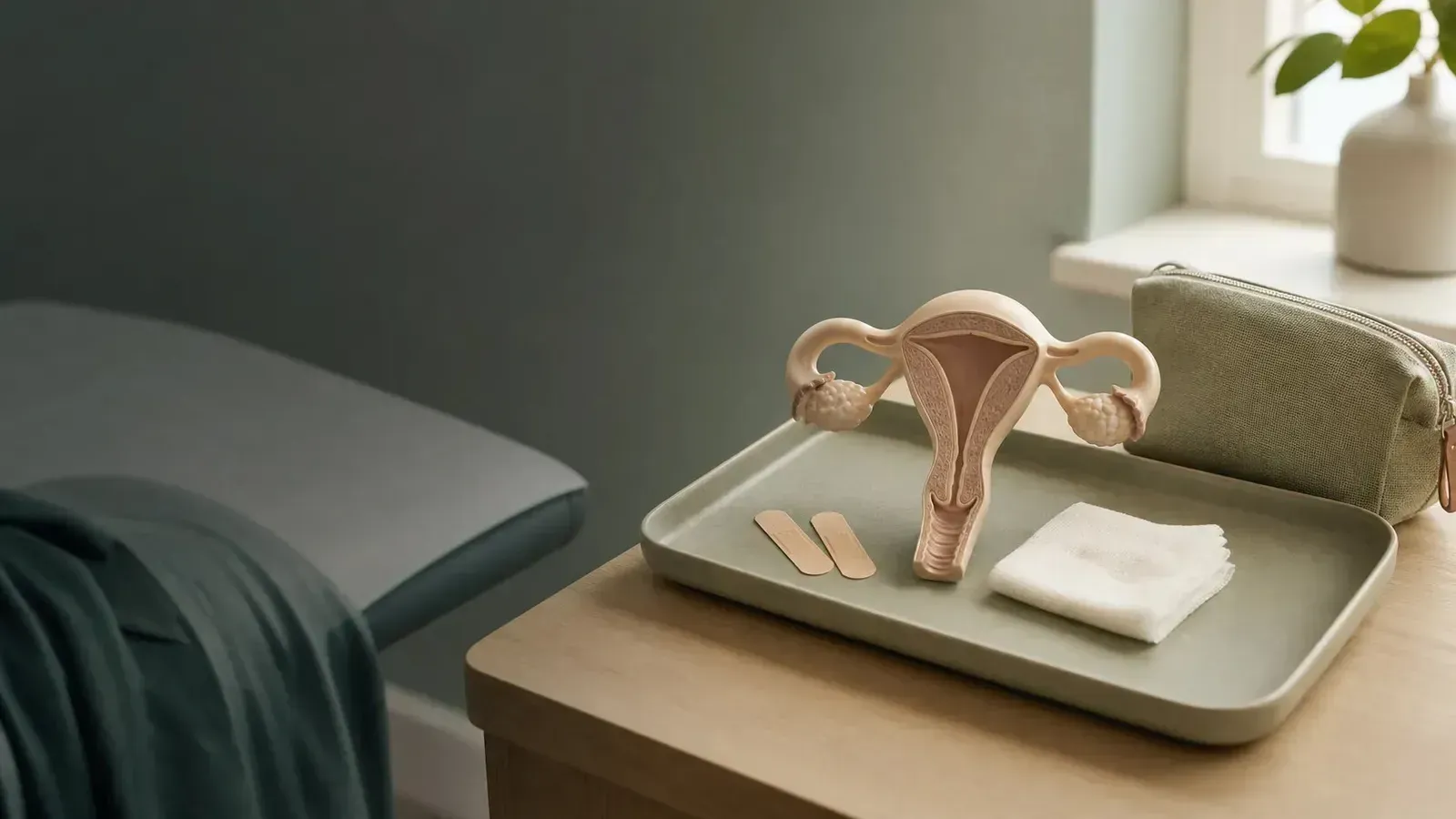
Painful periods that derail your week. Pelvic pain that won’t quit. A doctor who said “it’s just bad cramps.” If any of this resonates, you’re not alone — and you might be looking for words for something the people around you have been calling “normal“ for too long.
Endometriosis affects roughly 1 in 10 menstruating people. Yet the average diagnosis takes seven to ten years. That delay rarely comes from medical complexity — it comes from generations of normalizing severe period pain. This guide explains what endometriosis is, the symptoms to recognize, how it’s diagnosed, and what treatment looks like, all in plain language.
Jump to: Symptoms · Diagnosis pathway · Treatment · Fertility · Free symptom test · Stages
What endometriosis is — the plain definition
In endometriosis, tissue similar to the lining of the uterus (endometrium) grows outside the uterus. It sounds harmless at first, but here’s the catch: this tissue behaves like normal uterine lining — it responds to the hormonal shifts of your cycle, it builds up, and it bleeds during your period. Unlike a normal period, that blood has nowhere to go. It stays inside the body, causing inflammation, scarring, and adhesions.
Over months and years, this can develop into chronic pain, ovarian cysts (called endometriomas), and in some cases, fertility problems. What’s critical to know: endometriosis is a chronic, hormonally-influenced condition — but it is not psychosomatic, not caused by stress, and not the result of your lifestyle. If you’ve ever been told “it’s all in your head” or “you just need to handle it better,” that was medical misinformation.
Where endometriosis grows in the body
Endometriotic lesions can form in several places in the pelvis. The most common locations are the ovaries (where endometriomas — sometimes called “chocolate cysts” — develop), the fallopian tubes, the peritoneum (pelvic lining), the ligaments that support the uterus, the bowel (especially near the rectum), and the bladder or ureters. In rarer cases (extragenital endometriosis), lesions can appear in the abdominal wall (often around cesarean scars), the diaphragm, or, very rarely, the lungs.
The four stages of endometriosis
Endometriosis is staged from I (minimal) to IV (severe), using the American Society for Reproductive Medicine (rASRM) classification.
- Stage I (minimal): few superficial lesions, little to no scarring
- Stage II (mild): more lesions, some deeper, light adhesions
- Stage III (moderate): multiple lesions, endometriomas on at least one ovary, significant adhesions
- Stage IV (severe): extensive lesions, large endometriomas on both ovaries, dense adhesions, often involving bowel or bladder
One critical point that’s often misunderstood: stage does not predict how much pain you’ll have. Someone with stage I endometriosis can be in unbearable pain; someone with stage IV can be nearly asymptomatic. Stage matters for surgical planning — not for the legitimacy of your suffering. More on this in our stages of endometriosis deep-dive.
Endometriosis symptoms — what you might feel
Endometriosis symptoms extend far beyond severe period pain. The complete clinical list lives in Endometriosis Symptoms, but here’s the overview:
- Period-related: severe period pain that doesn’t respond well to standard painkillers; heavy bleeding with clots; pain starting days before the period and lasting after it ends
- Throughout the cycle: chronic pelvic pain even outside the period; pain during or after sex (dyspareunia); cyclical lower back or leg pain
- Bowel and bladder: pain during bowel movements (especially during the period); pain urinating; changes in bowel habits; “endo belly” (significant, sometimes painful bloating)
- General: chronic fatigue, brain fog, cycle-linked mood changes, sleep problems
- Fertility: difficulty getting pregnant, recurrent early miscarriage
If you recognize several of these patterns, our free 5-minute symptom screener helps you map your symptoms against typical endometriosis presentations — not as a diagnosis, but as preparation for the conversation with your doctor.
What causes endometriosis?
The honest answer: we don’t fully know. Decades of research have produced several overlapping explanatory models that, together, give an increasingly clear picture. The four main mechanisms:
Retrograde menstruation (Sampson, 1927): some menstrual blood flows backward through the fallopian tubes into the pelvic cavity, where endometrial cells can implant. This happens in about 90% of menstruating people — but only a fraction develop endometriosis, so it’s part of the story, not the whole one.
Genetic predisposition: if a first-degree relative has endometriosis, your risk is 5-7 times higher. Recent genome-wide studies have identified over 40 gene regions linked to endometriosis risk.
Immune dysfunction: a healthy immune system should clear stray endometrial cells. Research shows altered immune responses in people with endometriosis.
Hormonal influences: estrogen fuels endometriotic growth, which is why most treatments aim to suppress estrogen or block its effect.
More on this in What Causes Endometriosis?. Risk factors include family history, early menarche (before age 11), short cycles (under 27 days), heavy or long periods, and never having given birth. What endometriosis is not caused by: stress, lifestyle, poor diet, or “toxic thinking.” These can influence symptoms — they are not the cause.
How endometriosis is diagnosed
The diagnostic pathway involves clinical history with a symptom diary, a pelvic exam, transvaginal ultrasound, MRI when needed, and laparoscopy in select cases. Importantly, current ESHRE guidelines (2022) allow a clinical diagnosis without laparoscopy if symptoms and imaging are consistent — enabling earlier treatment.
The full step-by-step pathway with tips for shortening your diagnostic journey is in How is Endometriosis Diagnosed?.
Treatment options — an overview
Endometriosis isn’t curable — but it is highly treatable. Care is tailored to your symptoms, the disease severity, your life goals (especially fertility), and how you tolerate hormones:
- Pain management: NSAIDs (ibuprofen, naproxen) as the baseline; stronger painkillers as needed; heat, TENS, pelvic floor physical therapy
- Hormonal therapy: combined contraceptive pill (continuous use), progestin-only options (Dienogest, Mirena IUD), GnRH agonists/antagonists in severe cases
- Surgical treatment: laparoscopic excision of lesions; in selected severe cases, hysterectomy
- Adjunctive approaches: anti-inflammatory diet, pelvic floor PT, stress management, psychological support for chronic pain
- Fertility-specific: earlier referral to a fertility specialist (not the standard “12 months of trying” rule), IVF when needed
Full treatment overview in Endometriosis Treatment. For fertility specifically, see Can You Get Pregnant with Endometriosis?.
Living with endometriosis
Endometriosis is a chronic condition. That’s hard to hear — but it’s also one many women live full, meaningful lives with. What helps:
Tracking reveals patterns and lets you plan ahead. The Belle Cycle app helps you track symptoms precisely across cycles. Information gives you tools to anticipate rather than be surprised. Community with others who’ve been there changes how lonely the condition feels — endometriosis advocacy groups exist in nearly every country. Realistic expectations: treatment is symptom management over years, not a one-time repair. Done well, it means dramatically fewer pain days and a life shaped by you, not by pain.
When to see a doctor
See a doctor promptly if pain regularly interferes with your daily activities, if painkillers don’t bring adequate relief, if you have pain outside your period, if sex is regularly painful, if you’ve been trying to conceive for over 6–12 months without success, or if there’s blood in your stool or urine.
Bring two to three cycles of symptom tracking if possible — that’s the single biggest factor in a productive first appointment. If your GP doesn’t take the symptoms seriously, ask specifically for a referral to a gynecologist who specializes in endometriosis.
Frequently asked questions
How common is endometriosis?
Endometriosis affects about 1 in 10 menstruating people of reproductive age — roughly 190 million people worldwide. It’s underdiagnosed in part because symptoms get normalized as “bad periods.”
Can endometriosis go away on its own?
Before menopause, endometriosis typically doesn’t resolve on its own. Pregnancy or hormonal therapy can temporarily ease symptoms, but the underlying tissue usually persists until estrogen levels drop significantly at menopause.
Is endometriosis hereditary?
There’s a strong hereditary component — having a first-degree relative with endometriosis raises your risk 5-7-fold. It’s not a single-gene condition; multiple genetic and environmental factors interact. More in Is Endometriosis Genetic?
Can you get pregnant with endometriosis?
Yes — about 60-70% of people with endometriosis conceive without medical assistance. Endometriosis can reduce fertility (especially in severe cases), but it’s not a verdict of infertility. If you’re trying to conceive and have endometriosis, consider seeing a specialist earlier than the standard 12-month rule.
What's the difference between endometriosis and adenomyosis?
Endometriosis is endometrial-like tissue OUTSIDE the uterus (ovaries, fallopian tubes, peritoneum). Adenomyosis is endometrial-like tissue INSIDE the uterine muscle wall. They can co-occur. Adenomyosis tends to cause diffuse, heavy-bleeding-dominant pain; endometriosis more often causes cyclical pelvic pain.
How is endometriosis treated without surgery?
Hormonal therapy is the primary non-surgical option: combined or progestin-only contraception (continuous use), the Mirena IUD, GnRH therapy in severe cases. Plus pain management (NSAIDs, pelvic floor PT) and lifestyle adjuncts. Surgery is typically reserved for cases where medical therapy isn’t enough.
Sources
- European Society of Human Reproduction and Embryology (ESHRE). Endometriosis Guideline. 2022.
- National Institute for Health and Care Excellence (NICE). Endometriosis: diagnosis and management. Clinical Guideline NG73, 2017 (Update 2024).
- American College of Obstetricians and Gynecologists (ACOG). Practice Bulletin No. 114: Management of Endometriosis.
- Zondervan KT, Becker CM, Missmer SA. Endometriosis. N Engl J Med 2020;382:1244–1256.
- Nnoaham KE et al. Impact of endometriosis on quality of life and work productivity. Fertil Steril 2011;96(2):366–373.